Research
An annular low-pressure UV reactor, and the surface describing how much micropollutant survives it as the water's radical scavenging capacity and UV absorbance change.
Measuring how fast water consumes radicals
Radical scavenging capacity
Every model of an advanced oxidation process depends on knowing how quickly a given water consumes hydroxyl radicals — its hydroxyl radical scavenging capacity. Measuring that rate is slow, and the numbers do not always reproduce. We are optimizing a real-time instrument to overcome both problems, and using it to examine how hydroxyl radicals interact with natural organic matter.
-
Evaluating Interferences in the External Calibration Method for Hydroxyl Radical Scavenging Capacity Measurement
-
External Standard Calibration Method to Measure the Hydroxyl Radical Scavenging Capacity of Water Samples
Exploring what radicals do to micropollutants
Advanced oxidation
We apply both established and emerging treatment processes to generate strong oxidants such as hydroxyl radicals, and use them to break micropollutants apart. Simulation tools let us predict how far a compound degrades under realistic water conditions. Oxidation solves one problem and can create another, so we also study what forms during treatment and what remains afterward.
-
On the Increasing Competitiveness of UV/Cl to UV/H2O2 Advanced Oxidation as the Organic Carbon Concentration Increases
-
UV-Chlorine Advanced Oxidation for Potable Water Reuse: A Review of the Current State of the Art and Research Needs
-
Degradation of Cyclohexanecarboxylic Acid as a Model Naphthenic Acid by the UV/Chlorine Process: Kinetics and By-Products Identification
-
Effects of UV Light Path Length and Wavelength on UV/Chlorine versus UV/H2O2 Efficacy
Watching water in real time
Water quality monitoring
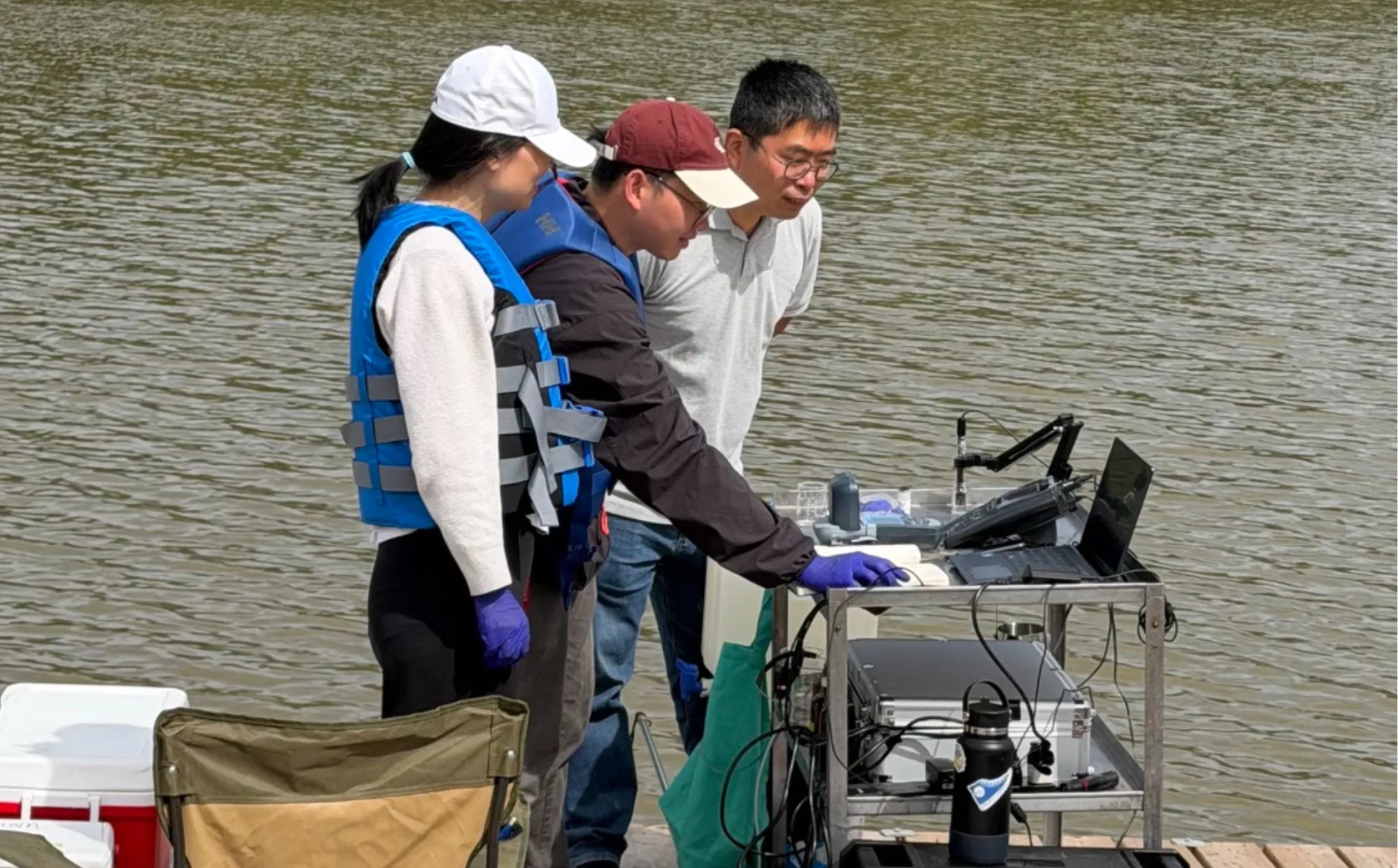
We are building instruments that measure water quality continuously and report it in real time. These are going into Manitoba waters — the Red River, the Upper Nelson River, and Lake Winnipeg — to map water quality at high resolution and identify pollutant hotspots.
Why reactions go where they go
UV photochemistry
We study how organic compounds absorb ultraviolet light, where radicals attack a given structure, and what the fragments become. Knowing why a process works is what lets you predict when it won't.
-
Reevaluation for UV Photolysis of Fe(III) Inducing Tetracycline Abatement: Overlooked Significance of Complexation-Assistance in Environmental Fates of Antibiotics
-
The Importance of Measuring Ultraviolet Fluence Accurately: A Review of Microcystin-LR Removal by Direct Photolysis
Try the UV/H₂O₂ model
The kinetics our work rests on, in a form you can push around. Change the water, the peroxide dose or the compound, and see how far the micropollutant actually degrades — and how much of that is the radical rather than the light. Contact Chengjin Wang at Chengjin.Wang@umanitoba.ca for more about this model, or about the group's other AOP models.